

Something significant is happening, and most nonprofits are either ignoring it or overcorrecting toward it. Neither posture serves the mission. And honestly, both are a little exhausting to watch.
The first ditch is avoidance. It looks responsible on the surface. "We're a people organization. We're not a tech company. Our donors give because of relationship, not algorithms." All of that is true, and none of it is a reason to ignore a shift that is already reshaping how organizations operate. Avoidance isn't neutrality. It's just a slower version of falling behind, with better talking points.
The second ditch is uncritical adoption. This one is more seductive, especially for leaders who are wired toward innovation. Every new AI tool feels like an opportunity. Every efficiency gain feels like a win. But organizations that chase AI without a framework for how it serves their mission end up with a lot of outputs and not enough wisdom. They automate things that should have stayed human. They publish things that sound polished but aren't true to their voice. They move fast and erode trust in ways they don't see coming until the damage is done. The road to a mediocre donor newsletter is paved with good intentions and bad prompts.
The organizations that will actually benefit from AI in the next three to five years are the ones who take a third posture: curious, deliberate, and mission-anchored.
They're asking not just "what can AI do?" but "what should AI do for us, given who we are and what we're trying to build?"
That posture starts with an honest look at both sides of what's coming.
AI Gift #1: The Small Team Gets Bigger
The resource gap between well-funded nonprofits and scrappy ones is real, and it has always shown up most painfully in staff capacity. There is a ceiling on what a small team can produce, and that ceiling limits everything from program delivery to donor cultivation to communications quality. AI changes that math in a meaningful way.
In the near future, a five-person team could operate with the output of an organization twice its size. Drafting donor communications, building content, synthesizing research, managing data, generating reports, those tasks don't disappear, but they stop consuming the hours your best people should be spending on the work only humans can do. Relationship. Strategy. Presence. Judgment. The organizations that figure this out early will have a genuine competitive advantage, not just in efficiency, but in talent retention and mission execution. When your team isn't buried in administrative output, they show up differently to the work that actually matters. Turns out people do better work when they're not drowning.
AI Gift #2: Donor Intelligence That Actually Works
Right now, most nonprofits are guessing about their donors. They know who gave and when, but not much about why, or who's likely to give again, or what kind of communication actually moves a particular person from curious to committed. The data exists inside most donor databases. The capacity to use it well usually doesn't. So it just sits there, quietly judging everyone.
AI-powered donor intelligence, already emerging in early platforms, could change that completely within a few years. Predictive modeling that identifies lapsed donors worth re-engaging. Messaging that adapts based on how a donor has responded in the past. Segments that go five layers deeper than "major gift" versus "annual fund." Giving patterns that reveal the right moment to make an ask. This is not science fiction. It is coming, and the nonprofits building clean data habits and strong CRM discipline right now will be the ones positioned to use it when it arrives. The organizations still running donor lists out of spreadsheets will not. Bless them, but they will not.
AI Gift #3: Storytelling at Scale
The most underfunded asset in most nonprofits is their story. They have compelling stories happening every week. Lives changed. Communities served. Quiet miracles that nobody outside the building ever hears about. They just can't produce them fast enough, in enough formats, across enough channels, to create the kind of consistent narrative presence that builds real donor loyalty over time.
AI won't replace the human at the center of the story. The program participant, the volunteer who has shown up every Saturday for six years, the staff member who took a pay cut because they believed in the mission, those voices cannot be manufactured and shouldn't be. But AI can help an organization take that story and carry it further. More formats. More platforms. More consistency. Without burning out the one person on staff who also answers the phones and orders the paper towels. The possibility here is a nonprofit that finally looks and sounds on the outside the way it actually is on the inside. That gap has cost the sector enormous amounts of donor trust and funding over the years. Closing it matters more than most leaders realize.
Now...the harder conversation...
AI Curse #1: Efficiency Without Integrity
Speed is only a gift if the content it produces is accurate, on-brand, and human. AI will generate things that sound right but aren't. It will produce donor communications that feel warm but miss the voice your community has come to trust. It will summarize reports in ways that are technically correct but contextually misleading. Organizations that don't build thoughtful review processes into their AI workflows will publish things they'll regret, and donor trust that took a decade to build can erode faster than anyone expects. Efficiency without integrity isn't a gift. It's a liability dressed up as progress, and it shows.
AI Curse #2: The Widening Gap
AI will not be equally accessible across the sector. Organizations with tech-savvy staff, reliable funding, a culture of learning, and leadership that takes this seriously will accelerate. Organizations without those things, which describes a significant portion of the nonprofit sector, will fall further behind. The productivity gap between well-resourced and under-resourced organizations could widen significantly before it narrows. That should concern funders, capacity builders, and sector leaders who actually care about the ecosystem and not just their corner of it. If AI becomes another advantage that only well-capitalized organizations can access, it will deepen existing inequities rather than address them. That would be a painful irony for a sector whose entire reason for existing is to close gaps.
AI Curse #3: Mission Drift Through Automation
There is a version of AI adoption that makes a nonprofit more productive and measurably less human. If the efficiency gains come at the cost of the relational texture that defines nonprofit work, something important has been lost and it won't always be obvious when it's happening. It creeps. A templated email here. An automated touchpoint there. One day you look up and realize your organization feels like a content machine with a mission statement bolted on. AI should serve the mission. The moment your programs, your communications, or your culture start bending to accommodate the AI workflow rather than the other way around, the organization has a real problem on its hands.
...so what do you do right now, practically?
Start with one thing.
Pick the most time-consuming repetitive task your team complains about every week and experiment with AI there first. Build the muscle before you build the dependency. Develop judgment about what it does well (at this point in time) and where it falls embarrassingly short. Create a review habit before you scale. Get your donor data organized. Invest in basic AI literacy across your team, not just the one person who already has seventeen browser tabs open about it. And get genuinely curious before you get either dismissive or dependent.
The organizations that will thrive in five years are not the ones who adopted AI fastest. They're the ones who adopted it wisely, with a clear sense of who they are, what they're building, and what they are not willing to automate away. That kind of clarity has always been what separates good nonprofits from great ones. AI just makes it more urgent to figure out which one you want to be.
Two AI Nonprofit Resources
Claude and
Nonprofits Cheat Sheet
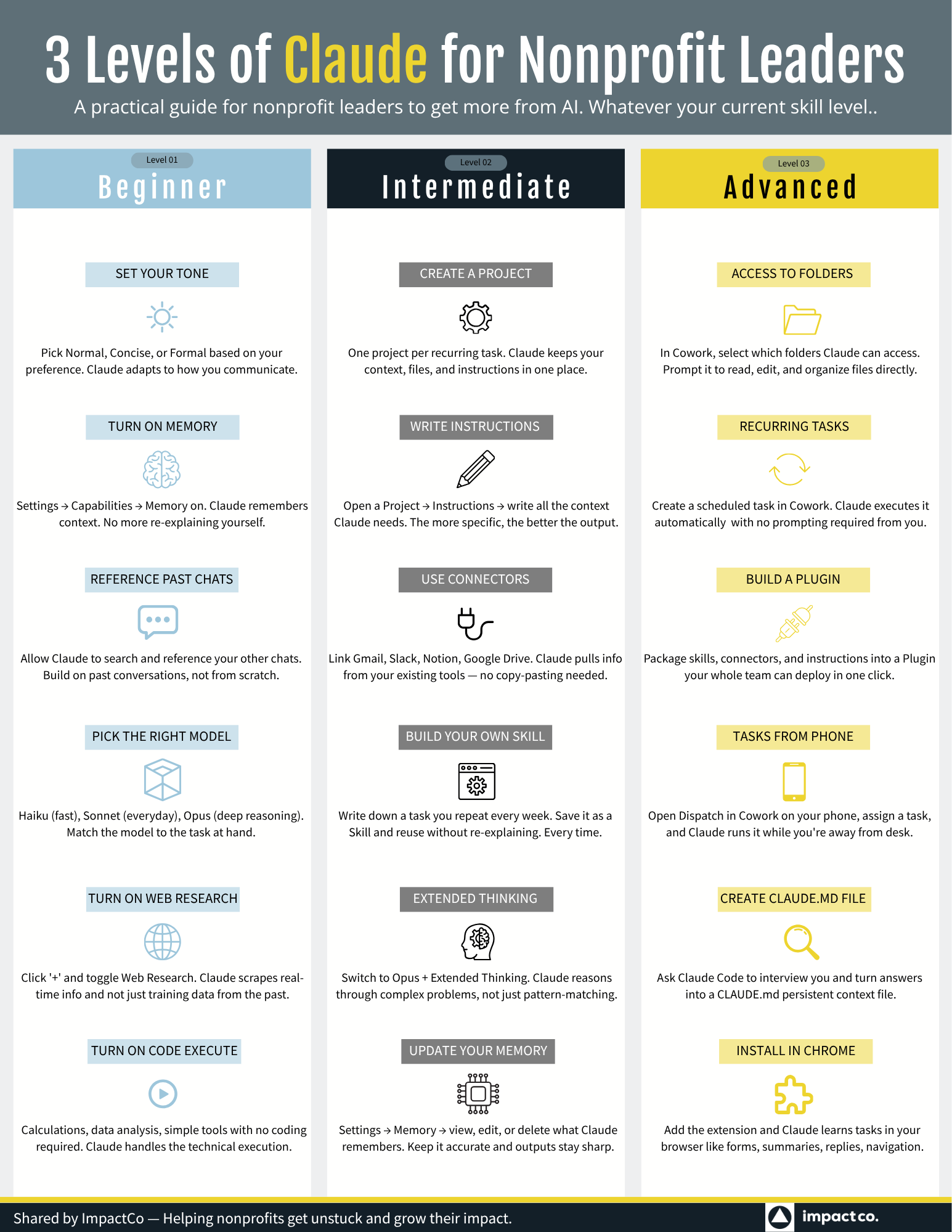
We've put together this helpful progression for learning Claude (the platform we currently use the most) that takes leaders from Beginnger to Intermediate to Advanced. Obviously these things will change as AI progresses, but we've found this to be a helpful cheat-sheet for leaders who are looking to get their bearings practically.
Pope Leo & AI
Summary & Commentary
We've put together this two-page overview of Pope Leo XIV's encyclical Magnifica Humanitas for nonprofit leaders, whether your organization is faith-based or completely secular. It walks through what the document actually says and why it matters for your work. Obviously the AI conversation will keep evolving, but we've found this to be a helpful starting point for leaders who want to engage the moral questions AI is raising right now